Loyalty Program

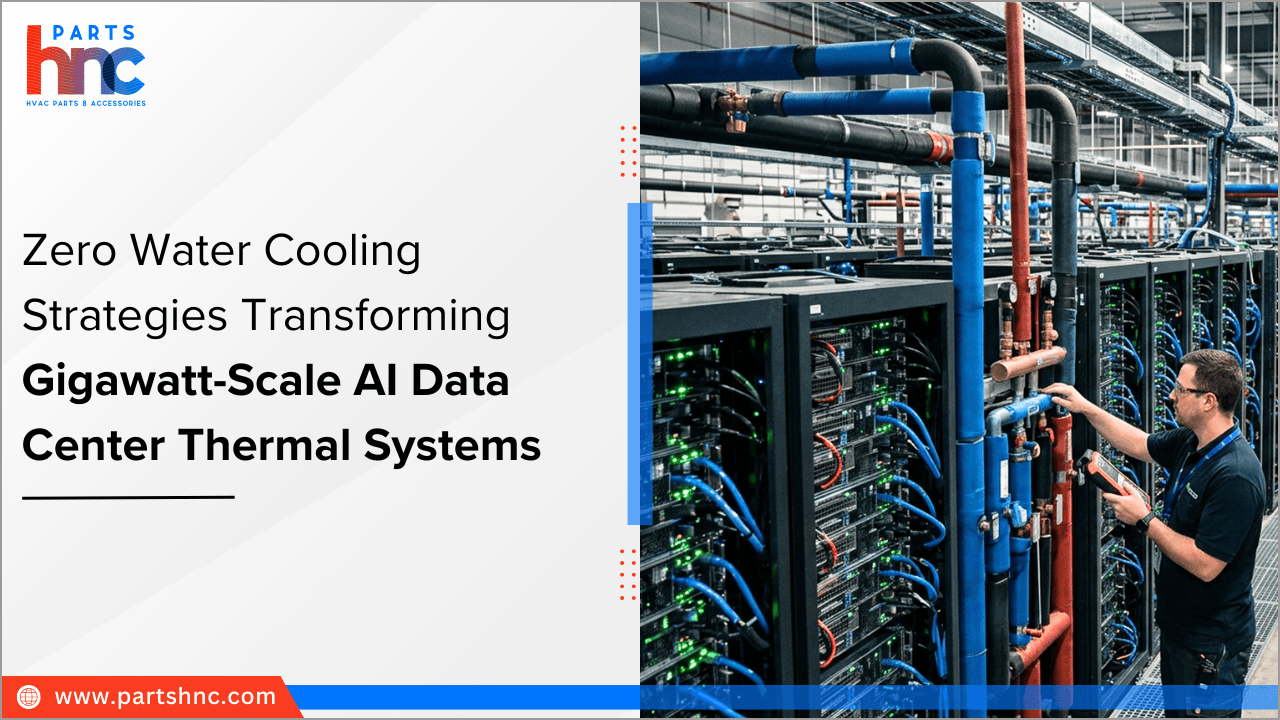
Zero Water Cooling Strategies Transforming Gigawatt-Scale AI Data Center Thermal Systems
Gigawatt-scale AI data centers are pushing conventional cooling systems to their limits, forcing operators to rethink how heat is managed at extreme densities. As training clusters grow larger and power consumption surges, traditional water-intensive cooling methods are becoming costly, complex, and environmentally constrained. This shift is accelerating interest in zero water cooling strategies that promise high efficiency without relying on massive water infrastructure.
From advanced liquid-to-chip systems to fully sealed immersion cooling and next-generation heat reuse designs, these innovations are reshaping thermal management at scale. Together, they are transforming how AI infrastructure stays stable under continuous, high-load computing demands while dramatically reducing environmental impact.
Why Zero Water Cooling Matters in AI Data Centers
AI data centers are fundamentally different from traditional cloud infrastructure. The energy density is far higher, and the thermal output is extreme. A single AI training cluster can consume energy equivalent to a small town.
Recent industry designs show that gigawatt-scale “AI factories” require advanced thermal planning that integrates the entire heat chain from chip to atmosphere.
According to recent industry reference designs, modern systems can now achieve:
-
Zero water consumption cooling architectures
-
Up to 32% improvement in annual energy efficiency
-
Elimination of cooling towers and evaporative systems
This marks a fundamental shift: cooling is no longer just a facility support function—it is a core design pillar of AI infrastructure.
Why Gigawatt-Scale AI Data Centers Need New Cooling Models
Modern AI workloads, especially large language models and multimodal training systems, generate unprecedented heat. Each GPU can consume over 1,000–1,400 watts, and full racks can exceed 100 kW or more in dense configurations. Traditional air cooling systems were designed for far lower thresholds and struggle beyond ~20 kW per rack in most configurations.
As a result, the industry is rapidly shifting toward liquid and hybrid cooling approaches, but water usage concerns, infrastructure limits, and environmental constraints are driving demand for water-free alternatives.
The goal is no longer just cooling efficiency; it is thermal independence from water systems.
Discover water pump integration in data centers as the backbone of HVAC cooling and emergency preparedness.
Core Zero Water Cooling Strategies Transforming Gigawatt-Scale AI Data Center Thermal Systems
Gigawatt-scale AI infrastructure is rapidly shifting from evaporative cooling to closed-loop, water-free or near-waterless systems. These methods aim to eliminate consumptive water use while efficiently managing extreme heat from high-density GPU clusters. Together, they form the foundation of next-generation zero-water cooling architectures in AI data centers.
1. Direct-to-Chip Liquid Cooling (Cold Plate Systems)
Direct-to-chip cooling is a widely used high-efficiency method in AI data centers. Liquid coolant flows through cold plates on CPUs and GPUs, removing heat directly at the chip level instead of using air cooling. It operates in a closed-loop liquid circuit using treated water or dielectric fluids, which reduces dependence on evaporative cooling systems.
The technology is widely used in NVIDIA HGX and DGX architectures and is being adopted by hyperscalers such as Microsoft and Google in pilot and production deployments.
2. Full Immersion Cooling (Single-Phase & Two-Phase)
Immersion cooling submerges servers in dielectric fluid for direct heat removal. Single-phase systems circulate liquid without phase change, while two-phase systems use boiling and condensation for higher heat transfer efficiency. These systems can eliminate cooling towers and significantly reduce water use, making them suitable for AI workloads exceeding 100 kW per rack.
3. Closed-Loop Heat Rejection (Dry Cooling Systems)
Dry cooling systems transfer heat from liquid loops to air using finned heat exchangers without using water or evaporation. Heat is moved through a sealed loop and released directly into the atmosphere, removing the need for water-based cooling. They are used in water-scarce and water-neutral AI data centers. This enables:
-
Zero operational water consumption
-
Deployment in arid and drought-prone regions
-
Scalability to large AI campuses at a gigawatt scale
-
Elimination of evaporative cooling infrastructure
4. Rear Door Heat Exchangers (RDHx)
Rear door heat exchangers mount cooling coils on the back of server racks to capture heat directly as it exits servers, preventing hot air from spreading into the data hall.
When combined with dry coolers or closed-loop systems, RDHx:
-
Reduces or eliminates facility-wide air conditioning
-
Improves overall cooling efficiency
-
Supports low-water or water-free cooling strategies
5. Warm Water Cooling Loops (Chiller-Free Designs)
Modern liquid-cooled systems increasingly operate at higher coolant temperatures (typically 30–45°C), allowing heat to be rejected directly into ambient air using dry coolers without energy-intensive chillers.
This shift reduces dependency on traditional chilled-water infrastructure and supports near-zero water cooling designs in optimized deployments.
6. AI-Optimized Thermal Management Systems
AI-based thermal control systems use sensor data and predictive models to continuously optimize cooling across racks and liquid loops based on workload, temperature, and power density. They are increasingly deployed in large-scale AI infrastructure. This helps:
-
Balance heat loads across servers in real time
-
Prevent unnecessary overcooling of equipment
-
Reduce total cooling energy usage
-
Maintain stable operation under variable workloads
7. Modular AI Pod Architecture (Thermal Segmentation)
Instead of monolithic data halls, modern AI facilities are increasingly built using modular pods, each with independent cooling loops and thermal control systems.
This architecture improves heat containment, simplifies scaling to gigawatt capacity, and reduces overall cooling complexity by localizing thermal
management within discrete compute clusters.
Rising Energy and Water Demand Driving Zero Water Cooling Adoption
The rapid expansion of AI infrastructure is dramatically increasing both energy consumption and water usage across modern data centers. As hyperscale AI clusters grow larger and more power-dense, operators are facing mounting pressure to reduce environmental impact while maintaining reliable thermal performance.
A recent report estimated that data centers consumed 10.8 terawatt-hours of electricity in 2023, compared to 5.5 terawatt-hours in 2019, accounting for nearly 6% of total national data center energy use during that period. If current growth trends continue, demand could reach 25 terawatt-hours by 2028, equivalent to the annual electricity consumption of approximately 2.4 million U.S. homes.
Environmental impact is also increasing alongside power demand. Estimated carbon emissions from the sector nearly doubled between 2019 and 2023, rising from 1.2 million tons to 2.4 million tons. During the same period, on-site water consumption increased from 1,078 acre-feet to 2,302 acre-feet, enough to supply the annual water needs of nearly 7,000 California households.
Summary: Future of Next-Generation AI Data Center Ecosystems
Next-generation AI data centers are expected to evolve from optimized cooling systems into fully self-regulating thermal ecosystems, where compute, power, and cooling operate as a unified adaptive layer. In these designs, heat is not just removed but actively managed, redistributed, and potentially reused across infrastructure and external systems.
Key takeaways:
-
Fully autonomous cooling systems driven by real-time AI control loops.
-
Direct integration of thermal management into chip and rack design.
-
Heat reuse for industrial, district, or secondary compute applications.
-
Near-zero water and minimal-energy cooling architectures at scale.
-
Tight coupling of workload scheduling with thermal optimization.
-
Modular, pod-based designs enabling distributed thermal control.
Why spend on a full HVAC overhaul when one part can fix it? Get it working instantly with affordable HVAC parts and supplies from PartsHnC. Buy premium components for heat pumps, furnaces, air conditioners, and more from leading brands like Carrier, Trane, Lennox, and Daikin. Experience great savings with competitive prices and rapid delivery straight to your door.
References:
https://www.ashrae.org/technical-resources/bookstore/datacom-series
https://www.fwpcoa.org/content.aspx?page_id=5&club_id=859275&item_id=130961
FAQs
Can air-cooled systems really support gigawatt-scale AI data centers?
According to Johnson Controls, yes. Its reference guide supports scalable air-cooled chiller plant designs for facilities up to 1 GW and highlights zero-water operation, major water savings, and energy performance improvements.
Is immersion cooling better than air cooling for AI systems?
For high-density AI workloads, immersion cooling is significantly more efficient than air cooling because it removes heat directly from hardware with minimal thermal resistance.
Will future AI data centers completely eliminate water use?
Not entirely in all cases, but next-generation designs aim for near-zero or zero consumptive water use, especially in large-scale AI campuses and desert deployments.
Are dry cooling systems effective for high-density AI workloads?
Yes. When combined with liquid cooling loops, dry coolers can support high-density workloads, including racks exceeding 100 kW, without using water for heat rejection.
|
Disclaimer: The content presented is intended for general awareness and discussion. It does not constitute professional engineering, environmental, or operational advice. It may not reflect finalized industry practices or regulatory standards. |