Loyalty Program


Trane HMWA Chiller: Magnetic-Bearing Technology, Modular Design & Controls
As cooling demands become more dynamic, chiller systems need to deliver efficient performance without adding unnecessary complexity. The Trane HMWA chiller takes a different approach by combining magnetic-bearing compressor technology with a modular design, creating a system built around efficient operation, flexible configuration, and precise cooling control.
Its engineering approach extends beyond the compressor itself. From modular construction to intelligent controls, the HMWA platform brings several design elements together to support changing load conditions and modern cooling requirements. Understanding how these features work together provides a clearer view of where this chiller fits within contemporary HVAC strategies.
What Is the Trane HMWA Chiller?
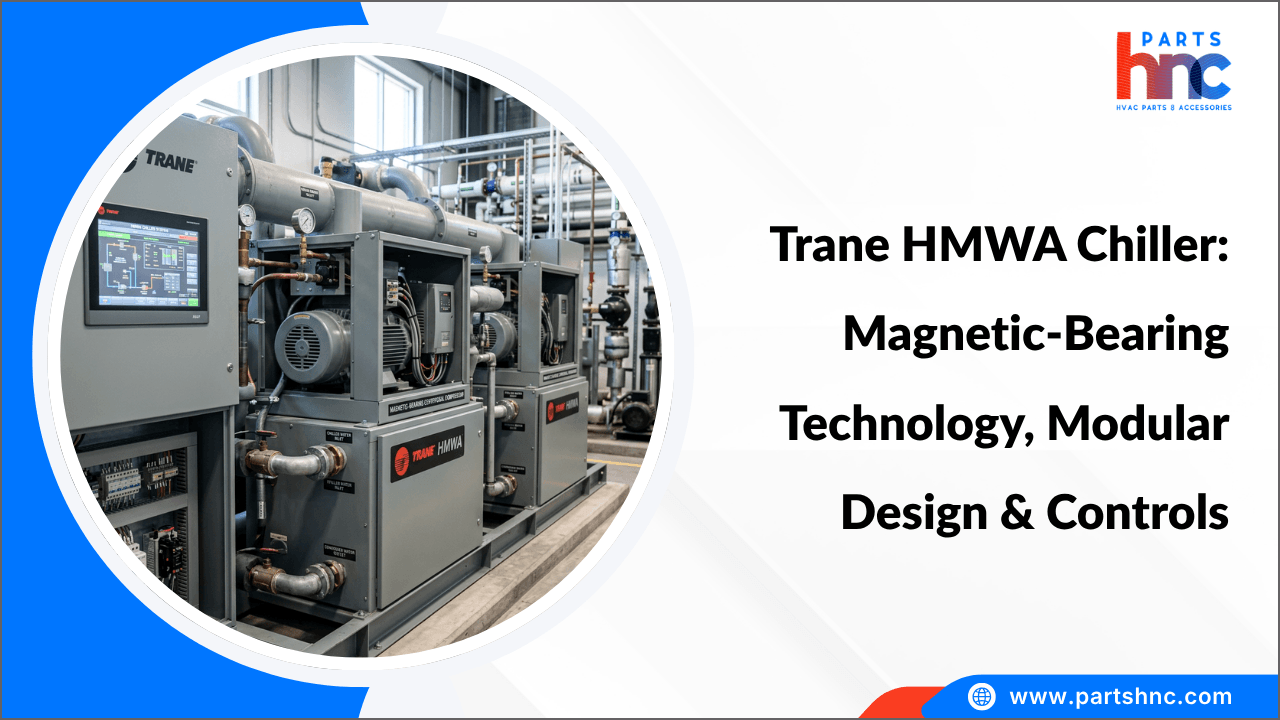
The Trane HMWA is a water-cooled centrifugal chiller. It cools water and sends it through a building's cooling system. The chilled water absorbs heat from the building, and the chiller removes that heat before the water is circulated again.
The HMWA is designed for large cooling systems. Its main characteristics include:
- Cooling capacity from 100 to 1,100 tons
- Water-cooled heat rejection
- A centrifugal compressor
- Magnetic bearings inside the compressor
- A modular configuration
The magnetic bearings support the compressor's rotating shaft while it operates. The modular configuration means the chiller system can contain multiple modules working together.
In practical terms, the HMWA is a large chiller that produces chilled water for a building’s cooling system. Its compressor and modular configuration play important roles in the system's design and operation.
Explore the transition in HVAC cooling technology from air to liquid: how HVAC cooling technology is evolving.
How Does Magnetic-Bearing Compressor Technology Work?
The Trane HMWA uses magnetic-bearing technology to support the rotating shaft inside its centrifugal compressor. Instead of using conventional bearings that physically contact the rotating shaft, magnetic forces keep the shaft positioned while it rotates.
Here’s How Each Main Component Functions Within the Compressor:
- Magnetic Bearings: Keep the compressor shaft suspended and properly positioned during operation.
- Compressor Shaft: Rotates while the compressor operates and compresses the refrigerant as part of the refrigeration cycle.
- Non-Contact Support: The magnetic bearings support the rotating shaft without direct physical contact.
- Refrigeration Cycle: The compressor provides the pressure difference needed for refrigerant to move through the chiller's refrigeration circuit.
The following illustration shows how compressor operation and chiller controls work together to manage the system.
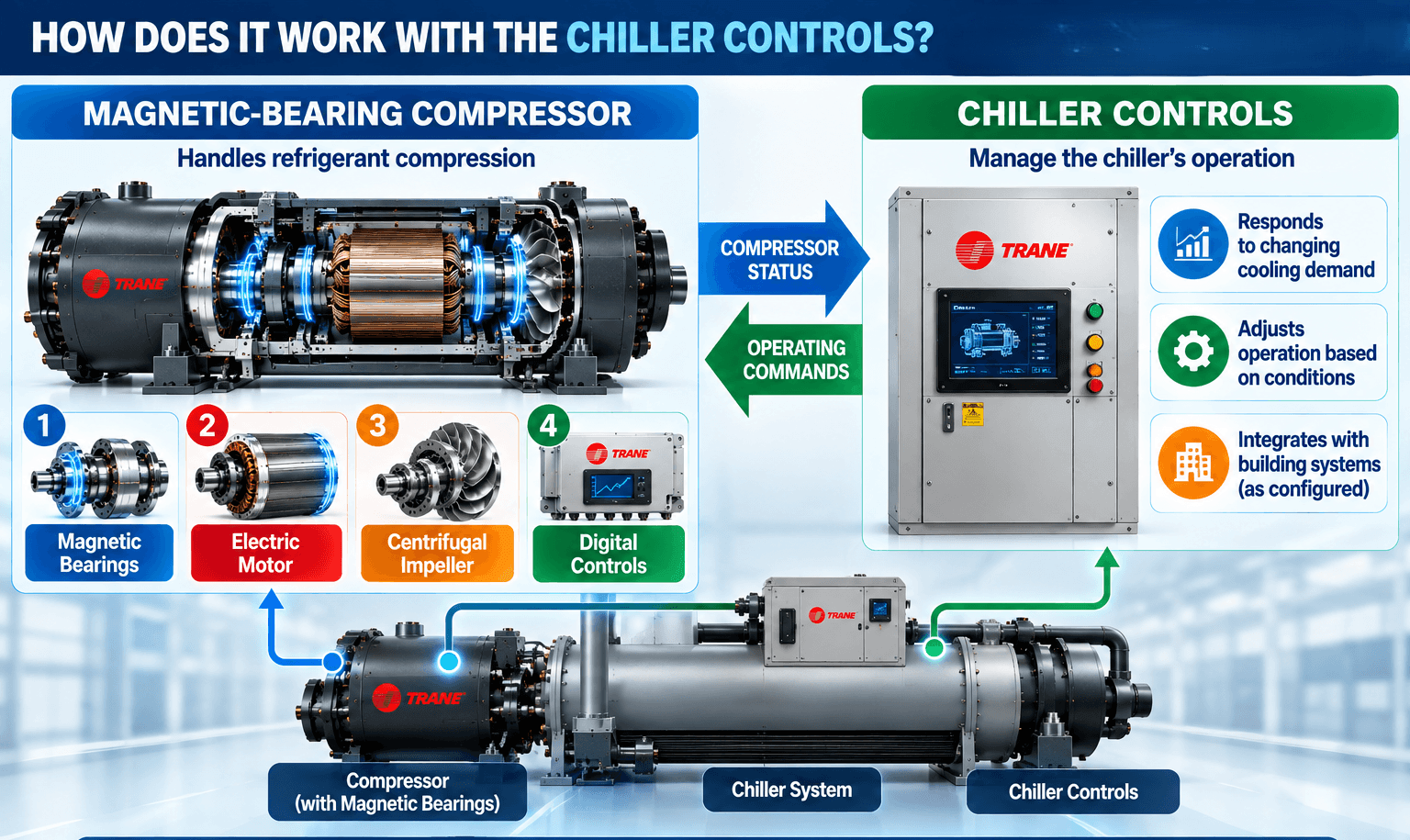
The magnetic-bearing system and chiller controls serve different functions during HMWA operation. The magnetic-bearing system supports the compressor shaft during rotation, while the controls coordinate chiller operation based on cooling demand and operating conditions.
In simple terms:
- Magnetic-Bearing System: Supports and maintains the position of the compressor shaft during operation.
- Compressor: Compresses the refrigerant as part of the cooling cycle.
- Chiller Controls: Manage the chiller's operating functions and response to changing cooling requirements.
How HMWA Modular Design Supports Future Cooling Capacity
The HMWA modular design supports phased capacity planning by aligning current cooling requirements with anticipated future demand. Key considerations are:
- Establish the Current load: Determine the cooling capacity required under present operating conditions.
- Estimate Future Demand: Consider changes such as building expansion, added process equipment, increased occupancy, or longer operating schedules.
- Define the Expansion Requirement: Identify how much additional cooling capacity may be needed as facility demand increases.
- Consider the Modular Arrangement: Evaluate how additional HMWA capacity could be incorporated into the planned chiller configuration.
- Plan the Expansion Sequence: Determine whether additional capacity would be required immediately or at a later stage of the facility's development.
- Coordinate the Plant Strategy: Consider how the planned HMWA configuration will work with the overall chilled-water plant as capacity requirements evolve.
This approach shifts capacity planning from a single current-load calculation toward a phased view of how the cooling plant may need to develop as facility requirements change.
Discover the benefits of double-digit building cooling: how porous plastic sheets enhance HVAC systems.
What Should Be Considered When Installing the HMWA Chiller?
Installing an HMWA chiller requires more than checking its footprint; delivery access, structural support, connections, and service space also need evaluation. The main installation factors are:
|
Installation Factor |
What to Confirm for the HMWA |
|
Unit dimensions |
Overall length, width, height, and weight for the selected configuration |
|
Service clearance |
Required clearance around the unit for inspection, maintenance, and component access |
|
Access route |
Door openings, corridors, lifting points, and equipment path from delivery area to final location |
|
Floor loading |
Whether the floor or foundation can support the chiller at its operating weight |
|
Piping clearance |
Space for chilled-water and condenser-water connections, valves, fittings, and insulation |
|
Electrical clearance |
Space required for power connections, controls, and electrical equipment |
|
Overhead space |
Clearance needed above the unit for installation and servicing |
|
Plant arrangement |
Space required for pumps, heat-rejection equipment, piping, and other connected components |
HMWA Installation Space Requirements
The HMWA's compact dimensions can simplify equipment placement, but the chiller footprint is only one part of the required installation space.
The mechanical room also needs space for:
- Chilled-water and condenser-water piping
- Valves, fittings, and pipe insulation
- Electrical and control equipment
- Service and maintenance access
- Equipment movement and installation work
- Connected pumps and heat-rejection equipment
Therefore, use the HMWA's actual dimensions as the starting point for space planning, then account for the surrounding installation requirements. Exact clearances and access requirements should be confirmed from the applicable HMWA installation documentation and project-specific layout.
How Are HMWA Efficiency, Refrigerant, and Control Performance Evaluated?
When evaluating the HMWA, look at how efficiently it operates, which refrigerant it uses, and how its controls manage operation. These areas help you understand the chiller's energy performance, refrigeration configuration, and operating functions.
1. Efficiency
Efficiency indicates the electrical power required to produce a given amount of cooling. HMWA efficiency is expressed in kW/RT under specified operating conditions.
- Full-Load Efficiency: 0.52 kW/RT at full load.
- Part-Load Efficiency: 0.31 kW/RT at part load.
- Load Conditions: Efficiency changes with cooling load, chilled-water temperature, condenser-water temperature, and water flow.
- Plant Conditions: Equipment configuration and plant operating strategy also affect actual power consumption.
- Performance Ratings: Published efficiency values apply to specific rating conditions and should not be used alone to estimate annual energy consumption.
2. Refrigerant
Refrigerant evaluation covers the refrigerant specified for the HMWA configuration and the requirements for its use.
- Refrigerant Type: Verify the refrigerant specified for the HMWA model and configuration.
- Environmental Requirements: Check applicable regulations for refrigerant use and emissions.
- Safety Requirements: Follow the required procedures for refrigerant handling and storage.
- Service Requirements: Use the specified procedures for refrigerant charging, recovery, and servicing.
- Regulatory Changes: Consider current and applicable refrigerant regulations when evaluating long-term equipment operation.
3. Controls
Controls regulate chiller operation as cooling demand and operating conditions change. They also coordinate the chiller with other plant equipment.
- Load Response: Control functions adjust chiller operation as cooling demand changes.
- Temperature Control: Sensors and control logic maintain the required operating conditions.
- Protection: Control functions monitor operating limits and protect the equipment when abnormal conditions occur.
- Plant Coordination: Chiller controls coordinate operation with pumps, heat-rejection equipment, and other connected systems.
- Building Automation: Supported communication functions can connect the chiller controls with a building automation system.
Note: HMWA efficiency ratings, refrigerant specifications, and control functions can vary by configuration and operating conditions.
Summary: Creating a More Flexible Future With Trane HMWA Chiller Design
The Trane HMWA combines magnetic-bearing compressor technology, modular construction, compact dimensions, and flexible capacity planning within a water-cooled centrifugal chiller platform. Its modular approach can support changing cooling requirements while installation, infrastructure, and future expansion remain important planning considerations.
Key Takeaways
- Magnetic-Bearing Technology: Supports the compressor's rotating assembly through magnetic forces rather than conventional mechanical contact bearings.
- Modular Design: Allows cooling capacity to be considered across multiple modules within a larger plant configuration.
- Flexible Capacity Planning: The HMWA range spans 100–1,100 tons, providing different capacity options for project requirements.
- Compact Installation: Compact dimensions can influence equipment placement, although the complete plant footprint also includes piping, electrical systems, controls, and service access.
- Efficiency Ratings: Specified efficiency values include 0.52 kW/RT at best full load and 0.31 kW/RT at best part load under their respective rating conditions.
- Future-Focused Planning: The modular approach can be considered alongside present loads, potential future changes, available infrastructure, and mechanical-room constraints.
Searching for the right HVAC components for your project? Shop HVAC parts and supplies from PartsHnC. Find parts for air conditioners, heat pumps, furnaces, and other HVAC systems from top brands like Carrier, Goodman, Rheem, Lennox, and York, with fast delivery straight to your door. Sign up for TradePro and get 500 reward points instantly, plus exclusive smart savings and offers through TradePro Rewards.
References:
https://www.gsa.gov/governmentwide-initiatives/federal-highperformance-buildings/highperformance-building-clearinghouse/emerging-technology-evaluations/hvac-technology/variablespeed-maglev-chiller
https://www.energy.gov/nepa/articles/cx-025201-create-spool-pieces-218-1h-trane-chiller-evaporator-piping
https://training.jacksonms.gov/virtual-library/ovZOHo/272015/trane__rtac-chiller__troubleshooting__guide.pdf
https://meetings.boardbook.org/Documents/DownloadPDF/2fc2dba3-a428-44fd-ba83-1ab54473e649?org=1897
https://www.mcaa.org/manufacturer-product/trane-series-r-helical-rotary-screw-chillers/
https://meetings.boardbook.org/Documents/DownloadPDF/2fc2dba3-a428-44fd-ba83-1ab54473e649?org=1897
FAQs
Does the HMWA's modular design guarantee easy future expansion?
No. Future expansion depends on available space and supporting infrastructure, including piping, electrical systems, heat rejection, access routes, and controls.
Does a compact HMWA dimension represent the complete installation footprint?
No. The overall plant also requires space for piping, valves, fittings, electrical equipment, controls, service areas, pumps, and heat-rejection equipment.
Are magnetic bearings and chiller controls the same technology?
No. Magnetic bearings support and position the compressor's rotating assembly, while controls determine how the equipment responds to operating conditions. They perform separate engineering functions.
What should be evaluated before integrating an HMWA into an existing chiller plant?
The assessment should include existing pumps, cooling towers, piping, electrical distribution, building automation controls, valves, sensors, and heat-exchanger equipment—not just the existing chiller.
|
Disclaimer: This article is provided for informational and educational purposes only. It is intended to help readers understand the Trane HMWA chiller, its technology, modular design, performance considerations, and installation factors. |