Loyalty Program

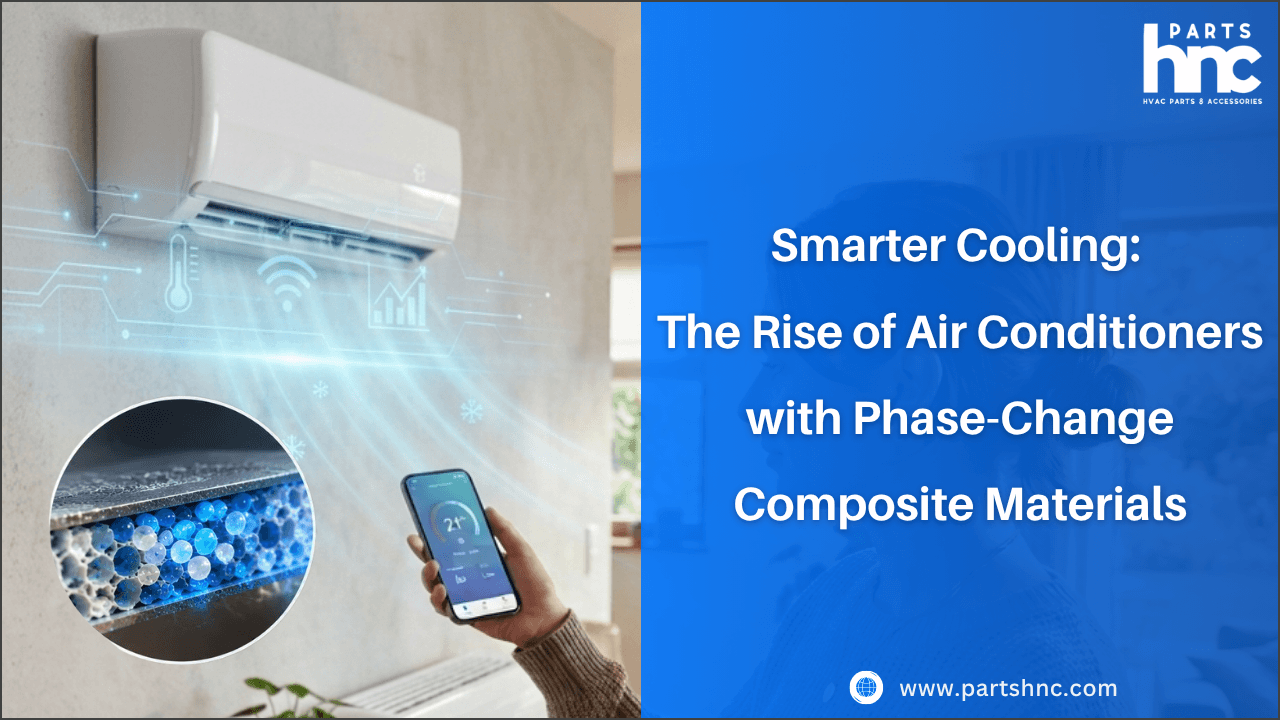
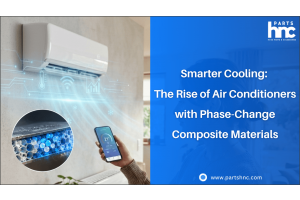
Smarter Cooling: The Rise of Air Conditioners with Phase-Change Composite Materials
As demand for energy-efficient air conditioners and advanced HVAC systems grows, phase-change composites are gaining attention for thermal energy storage. By storing thermal energy and managing heat fluctuations, PCMs can help modern AC systems provide consistent cooling while reducing the workload on conventional HVAC components.
The U.S. Department of Energy (DOE) has supported this technology, including $500,000 through its Technology Commercialization Fund for a project titled “Air Conditioner with Integrated Phase-Change Composite Material.” Research from agencies such as NIST and NREL has also explored how graphite-infused PCM composites can shift thermal loads, reduce equipment size, and lower peak electricity demand.
What Are Phase-Change Materials in Air Conditioning?
Phase-change materials (PCMs) in air conditioning are thermal storage substances such as paraffin wax, fatty acids, or salt hydrates that absorb and release large amounts of latent heat while transitioning between solid and liquid states at a nearly constant temperature.
How Does PCM Storage Work in an Air Conditioner?
- Off-Peak Charging: The compressor operates during periods of lower electricity demand, such as nighttime, to charge the PCM storage medium.
- Thermal Energy Storage: The PCM absorbs and stores thermal energy as it changes phase, functioning as a thermal battery within the cooling system.
- Peak-Period Cooling: When indoor cooling demand increases, the PCM releases its stored thermal capacity to help maintain the required indoor temperature.
- Heat Transfer: Depending on the system design, heat is transferred between the PCM and the refrigerant or air, allowing the stored thermal capacity to be used for cooling.
- Compressor Support: During peak cooling periods, the stored capacity can supplement the compressor, reducing the amount of cooling the compressor must produce at that moment.
- Load Shifting: Shifting stored cooling from off-peak to peak hours can reduce the cooling load during periods of high electricity demand.
PCMs can help modern AC systems deliver consistent cooling by storing thermal energy and managing heat fluctuations, while reducing the workload on conventional HVAC components. There are three different types of PCMs.
Why Are Phase-Change Composite Materials Used in Air Conditioning?
Phase-change composite materials combine latent heat storage with enhanced heat transfer, helping AC systems store cooling capacity and release it when needed. The main reasons for using PCM composites are:
- Starting With the PCM: A PCM provides the latent heat storage needed to store thermal energy during a phase transition. However, the material's heat-transfer characteristics determine how effectively that stored energy can be charged and released.
- Improving Thermal Performance With Graphite: This is where graphite becomes important. In the study “Enhancing Thermal Efficiency through the Use of Graphite-Infused Phase Change Materials in Roof Structures to Reduce Building Cooling Demand,” researchers found that adding graphite powder to paraffin-based PCM improved its thermal performance.
- Maintaining Latent Heat Storage: The same study reported approximately 153.65 J/g of latent heat for pure paraffin and 133.58 J/g for a composite containing 10% graphite by weight. This shows the balance required between adding conductive material and maintaining the PCM's energy-storage capacity.
- Accelerating the Phase Transition: That balance can also influence how quickly the PCM charges. The composite reduced melting time by approximately 35.94% compared with the unmodified PCM, indicating that the graphite-enhanced material could transfer heat more effectively during the phase transition.
- Applying the Concept to Air Conditioning: Building on this material approach, the DOE air-conditioning project uses a high-conductivity, shape-stable graphite-wax composite. In this design, wax provides phase-change storage, while graphite improves heat transfer through the composite.
- Turning Storage Into Part of the Heat Exchanger: The concept goes beyond placing PCM in a separate storage tank. The composite is incorporated into a dual-circuit phase-change heat exchanger that integrates with a vapor-compression air conditioner. This allows thermal storage and heat exchange to work together within the same system.
- Separating When Cooling Is Stored and Used: The system can also separate charging and discharging. The compressor charges the thermal storage according to grid requirements, while a pump discharges the stored cooling according to the building's cooling requirements. This allows cooling to be stored when it is advantageous and used later when the building needs it.
- Supporting Peak-Load Management: As a result, the air conditioner does not have to produce all of its required cooling at the exact moment demand reaches its highest level. Stored thermal capacity can help meet part of the load, creating greater flexibility for peak-demand management and grid-responsive cooling.
What Makes PCM Composites More Effective?
The key advantage is combining latent heat storage with improved heat transfer. Graphite enhances PCM thermal conductivity, while graphite-wax composites can integrate thermal storage directly into an AC heat exchanger, supporting peak-load shifting and demand response.
How Phase-Change Materials Improve Air Conditioner Efficiency
Phase-change materials improve air conditioner efficiency by storing thermal energy and releasing it when cooling demand increases. This helps the compressor manage cooling loads more strategically, reduce peak operation, and maintain stable indoor conditions. Here’s how phase-change materials improve AC performance:
-
Reduce Compressor Workload: PCM storage can absorb excess thermal energy during lower-demand periods, allowing the compressor to provide less cooling during periods of high demand. This can reduce the need for prolonged high-load compressor operation.
-
Shift Cooling Production to Off-Peak Hours: An integrated PCM system can charge its thermal storage when electricity demand is lower and use the stored cooling later. This separates cooling production from the exact time when cooling is needed.
-
Reduce Peak Electricity Demand: Stored thermal capacity can supply part of the building’s cooling load during peak periods. This can reduce the amount of cooling that must be produced directly by the compressor when electricity demand is highest.
-
Maintain More Consistent Indoor Temperatures: PCM materials can absorb and release heat around their phase-change temperature, helping moderate changes in thermal conditions and support more stable indoor temperatures.
-
Improve Overall Thermal Management: By combining thermal storage with the air conditioner’s cooling cycle, PCM technology provides greater flexibility in managing heat loads, compressor operation, and cooling demand.
Technical Insight: Decoupling Cooling Demand
PCM technology stores cooling energy during low-demand periods and releases it when demand rises. Macro- and micro-encapsulation help contain PCMs for thermal storage and cooling applications, allowing the system to shift cooling capacity to peak periods and reduce real-time compressor demand.
Explore side discharge heat pumps in 2026: how they redefine efficient heating and cooling.
What Makes a PCM Air Conditioner Different From a Standard AC?
A standard air conditioner responds mainly to immediate cooling demand, while a PCM-integrated system adds thermal storage to shift cooling capacity and manage peak loads. The key differences are:
|
Feature |
Standard Air Conditioner |
PCM-Integrated Air Conditioner |
|
Immediate Cooling |
Yes |
Yes |
|
Thermal Energy Storage |
Typically not integrated |
Integrated |
|
Load Shifting |
Limited |
Designed to support it |
|
Peak Compressor Operation |
Primarily responds to immediate cooling demand |
Stored cooling can supplement the compressor during peak periods |
|
Cooling During Storage Discharge |
Requires active cooling operation |
Stored thermal capacity can support cooling during discharge |
|
Demand Response Potential |
More limited |
Greater flexibility |
|
Charging and Discharging |
Not separated |
Separate functions |
|
Grid-Responsive Operation |
Limited by conventional operation |
Designed for greater flexibility |
|
Thermal Storage Medium |
None in standard configuration |
Phase-change composite |
|
System Complexity |
Conventional vapor-compression components |
Vapor-compression system plus thermal storage and associated controls |
Where Are PCM-Integrated Air Conditioners Being Used?
PCM-integrated air conditioners are primarily suited to buildings with high or variable cooling demand, such as:
- Residential Buildings: PCMs in residential settings store cooling during low-demand periods for later use.
- Commercial Buildings: Using PCSMs in commercial spaces help manage daytime and peak cooling loads.
- Office Buildings: Align cooling storage with occupancy and working hours.
- Data Centers: Data centers demand intense cooling, and PCMs provide additional thermal storage for high cooling loads.
- Industrial Facilities: PCMs support cooling where large or variable thermal loads occur.
The PCM approach therefore does not necessarily replace conventional cooling technology. Instead, it adds thermal storage and control capabilities to the existing vapor-compression architecture.
Discover double-digit building cooling: how porous plastic sheets enhance HVAC systems.
What Are the Challenges of Using Phase-Change Materials in AC Systems?
PCMs offer thermal storage benefits, but several technical challenges can affect their performance and integration into air conditioning systems. The main challenges are:
1. Low Thermal Conductivity
- Problem: Many PCMs, especially paraffin-based materials, transfer heat slowly.
- Impact: Slow heat transfer can delay PCM charging and discharging, making it harder to respond quickly to changing cooling demand.
- Ways to resolve: Fins, heat pipes, conductive additives, and improved heat-exchanger designs can increase heat-transfer rates.
2. Phase Separation and Supercooling
- Problem: Some salt-hydrate PCMs can separate during melting, while some PCMs can remain liquid below their normal freezing temperature, a condition known as supercooling.
- Impact: These effects can prevent the PCM from completing its phase change effectively and reduce usable thermal storage capacity.
- Strategic Interventions: PCM formulations, nucleating agents, stabilizers, and suitable containment designs can help control these problems.
3. Volume Change and Leakage Risk
- Problem: PCMs can change volume when transitioning between solid and liquid states, and some organic PCMs become liquid during operation.
- Impact: Volume changes can place stress on storage containers, while liquid PCM can leak if containment is inadequate.
- Strategic Interventions: Properly designed macro- or micro-encapsulation can contain the PCM and accommodate volume changes.
4. Material Degradation and Corrosion
- Problem: Repeated melting and solidification can degrade some PCMs, while certain salt hydrates can corrode metal components.
- Impact: Degradation can reduce thermal storage performance, while corrosion can damage PCM containers and system components.
- Strategic Interventions: Stable PCM formulations, compatible container materials, protective coatings, and cycle testing can improve long-term reliability.
5. Space and System Integration
- Problem: PCM storage requires additional space and must be integrated with the AC system's heat-transfer components.
- Impact: PCM modules can increase system size and weight. They can also increase airflow or fluid-flow resistance, potentially requiring additional fan or pump power.
- Strategic Interventions: Compact PCM modules, optimized heat-exchanger designs, and efficient airflow or fluid-flow paths can reduce space and energy requirements.
Control and Operating Coordination
PCM-integrated AC systems require coordinated control of the compressor, PCM charging and discharging cycles, and cooling demand. The control system determines when to store cooling capacity and when to release it, ensuring the PCM is available during periods of higher demand. Proper coordination helps prevent premature discharge and ensures the stored thermal capacity is used effectively.
Summary: The Future of PCM-Integrated Air Conditioning Systems
PCM-integrated air conditioning adds thermal energy storage to conventional cooling systems, allowing cooling capacity to be stored during lower-demand periods and used when demand increases. Graphite-enhanced PCM composites can improve heat transfer while supporting peak-load shifting, compressor support, and demand response. Although challenges such as thermal conductivity, material stability, space, and control remain, continued development could expand PCM use in efficient residential and commercial cooling.
Key Takeaways
- PCMs store and release thermal energy during phase changes.
- PCM-integrated AC systems can shift cooling capacity from off-peak to peak periods.
- Graphite-enhanced composites can improve PCM heat-transfer performance.
- Stored cooling can support the compressor during peak demand.
- PCM systems can provide greater flexibility for demand response and thermal load management.
- Wider adoption depends on addressing material, integration, space, and control challenges.
Planning an AC upgrade or repair? Shop HVAC parts and supplies from PartsHnC. Find AC parts, including compressors, fan motors, capacitors, coils, thermostats, control boards, and more from top brands like Carrier, Goodman, Rheem, Lennox, and York, with fast delivery straight to your door. Sign up for TradePro and get 500 reward points instantly, and enjoy exclusive smart savings and offers through TradePro Rewards.
References:
https://www.ashrae.org/news/esociety/recharging-phase-change-material-storage-for-personal-conditioning-systems
https://en.wikipedia.org/wiki/Phase-change_material
https://escholarship.org/uc/item/1024f8p5
https://www.energy.gov/cmei/buildings/articles/air-conditioner-integrated-phase-change-composite-material
FAQs
Are Phase-Change Materials Suitable for Every Air Conditioner?
No. Their suitability depends on the AC system’s cooling load, operating schedule, available space, and whether thermal energy storage can provide a practical benefit. They are particularly useful for systems that need to shift cooling capacity from off-peak to peak periods.
How Do PCMs Save Energy in AC Systems?
PCMs store cooling capacity during off-peak periods and release it when cooling demand increases. This can reduce peak compressor operation and shift part of the cooling load to periods when electricity demand is lower.
Do Phase-Change Materials Replace Refrigerants?
No. PCMs do not replace refrigerants in conventional vapor-compression systems. Instead, they add thermal energy storage that can support the refrigeration system during periods of higher cooling demand.
How Long Can PCM Materials Store Cooling?
The storage duration depends on the PCM material, the amount of PCM used, insulation, and system design. The stored cooling capacity is released as the PCM undergoes its phase transition during the discharge cycle.
Are PCM Air Conditioners More Efficient Than Conventional ACs?
PCM-integrated AC systems can improve energy management by shifting cooling production to off-peak periods and reducing peak compressor operation. However, the actual efficiency benefit depends on the PCM properties, system design, operating conditions, and control strategy.
Are Phase-Change Materials Safe for Residential Air Conditioners?
Yes, when the PCM material, encapsulation, and other system components are properly selected for the application. Appropriate containment is also important to prevent leakage and ensure reliable operation during repeated phase-change cycles.
|
Disclaimer: The information provided in this article is for general informational purposes only. PCM-integrated air-conditioning performance can vary depending on the system design, PCM material, operating conditions, climate, and installation. |