Loyalty Program

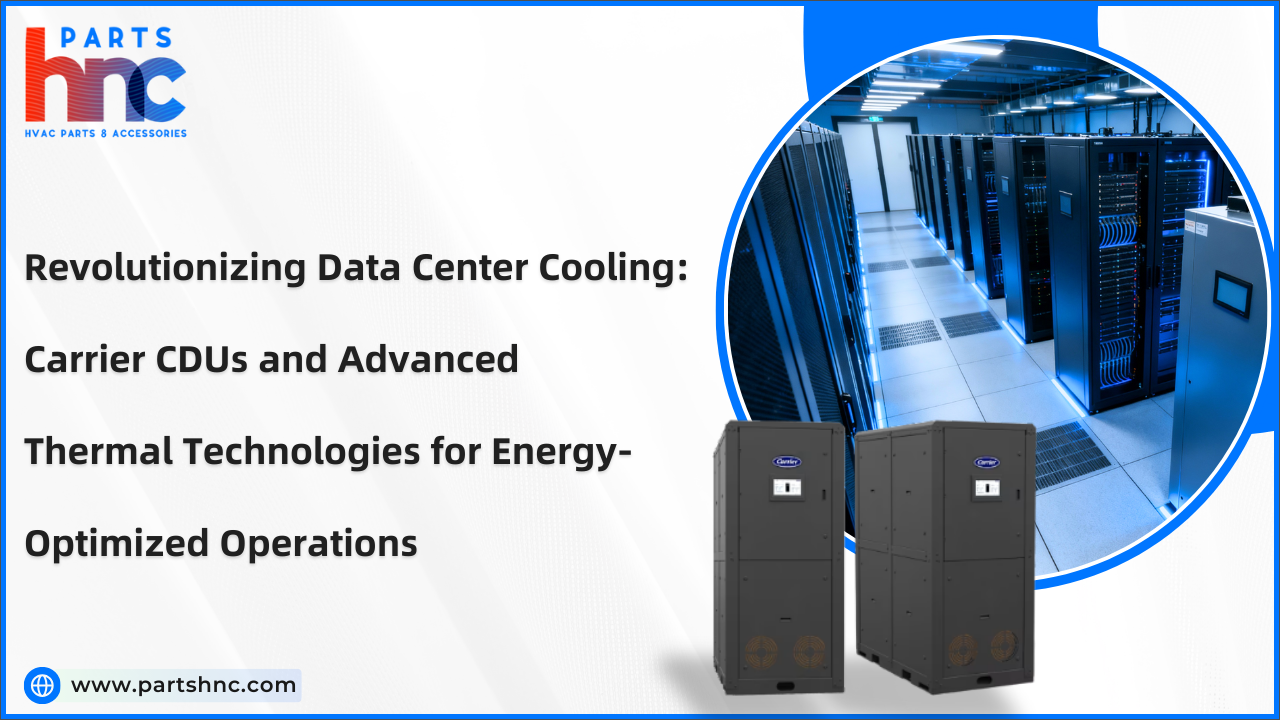
Revolutionizing Data Center Cooling: Carrier CDUs and Advanced Thermal Technologies for Energy-Optimized Operations
Data centers are the backbone of today’s digital world, supporting everything from cloud computing to AI workloads. As demand for performance and reliability grows, so does the need for efficient and sustainable cooling solutions. Traditional methods are often energy-intensive and costly, making advanced cooling technologies essential for modern data centers.
Carrier’s Coolant Distribution Units (CDUs), combined with modular heat exchangers and direct-to-chip technology, offer a revolutionary approach. These systems optimize thermal management, reduce energy consumption, and enhance operational efficiency. By integrating cutting-edge thermal technologies, Carrier enables data centers to achieve energy-optimized operations while maintaining peak performance, helping businesses meet both operational and sustainability goals.
How Carrier CDUs Drive Efficiency in Modern Data Centers
As data centers grow increasingly complex, maintaining reliable, energy-efficient cooling has become a critical challenge. Conventional methods often fall short, leading to higher costs and operational inefficiencies. Carrier Coolant Distribution Units (CDUs) provide a smarter approach, delivering precise cooling while optimizing energy use.
Ways Carrier CDUs Enhance Data Center Efficiency:
-
Precision Cooling: Direct-to-chip technology and modular heat exchangers deliver coolant exactly where it’s needed, minimizing energy waste.
-
Reduced Energy Demand: Low-resistance flow design lowers the power required for pumps and chillers, cutting operational expenses.
-
Flexible Scalability: From 1,350 kW up to 5 MW, Carrier CDUs can be tailored to fit both small-scale and large-scale data centers.
-
Space-Saving Design: Compact cabinets with three-side access make installation and maintenance easier in tight mechanical spaces.
-
Smart Monitoring: Integration with WebCTRL® and DCIM software allows seamless oversight of thermal and IT infrastructure.
-
Sustainable Operations: Energy-optimized performance reduces carbon footprint while supporting continuous, high-reliability operations.
With a combination of innovative thermal technologies and intelligent design, Carrier CDUs empower data centers to operate efficiently, sustainably, and reliably, meeting today’s demands and future growth.
How Modular Heat Exchangers and Direct-to-Chip Cooling Power Energy-Optimized Data Centers
Carrier’s modular heat exchangers and direct-to-chip cooling deliver precise, energy-efficient thermal management. These technologies optimize data center performance while minimizing energy consumption.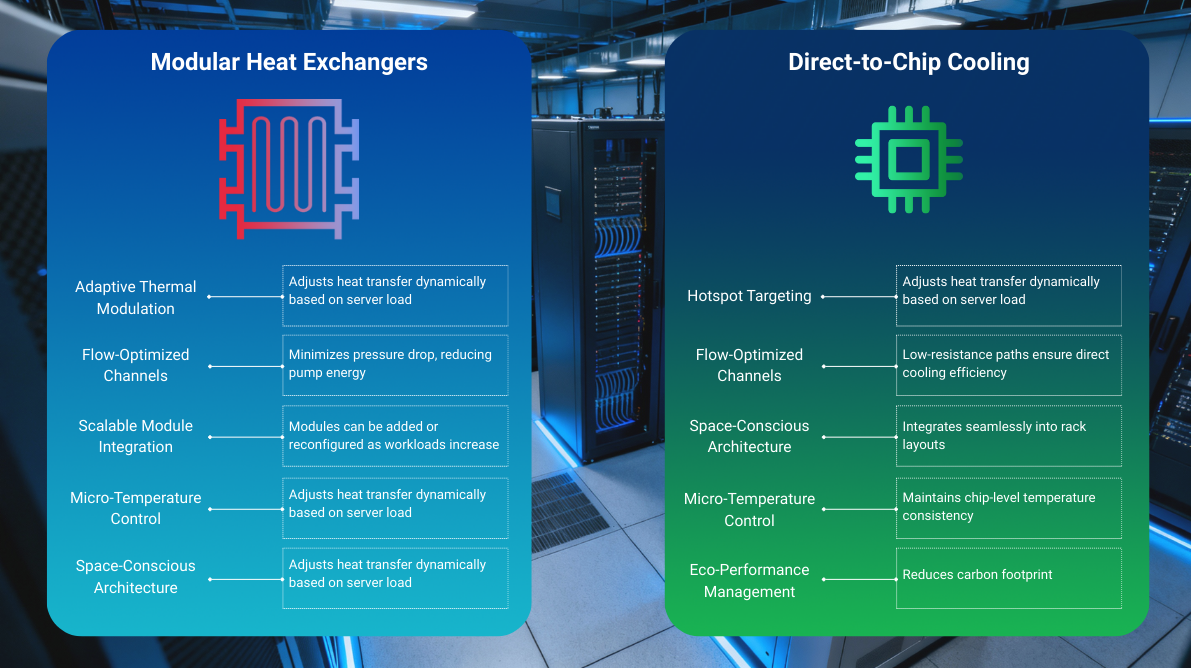
Driving Energy Savings and Performance with Next-Generation Thermal Innovation
Advanced thermal technologies make it possible to control heat more precisely, lower energy use, and improve system reliability. With smart sensors, efficient cooling materials, and automated controls, many types of devices and setups can operate longer, safer, and more efficiently.
Superior Heat Movement and Dissipation: Advanced materials and heat exchangers allow heat to move faster and more evenly.
Example: A control panel equipped with high-conductivity composite heat sinks maintains internal components at 45°C, rather than allowing them to rise to 70°C, thereby preventing heat accumulation.
Lower Mechanical and Electrical Stress: Stable temperatures reduce strain on moving and electrical parts.
Example: A brushless DC motor uses a temperature-responsive controller that prevents it from crossing 60°C, keeping it far below its usual peak of 85°C during continuous operation.
Extended Equipment Lifespan: Consistent thermal balance reduces long-term deterioration.
Example: A cooling unit with automated thermal modulation maintains a steady 30–35°C, allowing the unit to operate for several extra years without major part replacements.
Intelligent Sensing and Adaptive Automation: Sensors react instantly to temperature changes for better control.
Example: A server cabinet utilizes real-time sensors to redirect airflow only when temperatures exceed 40°C, thereby reducing fan workload while maintaining critical zones at a temperature below 45°C.
Reduced Energy Demand and Operating Costs: Smarter thermal behavior avoids unnecessary power cycles.
Example: A variable-speed cooling setup increases compressor speed only when temperatures exceed 32°C, cutting energy use by avoiding full-power cooling at lower temperatures.
Versatile Efficiency Across Multiple Uses: Advanced thermal management improves performance in many equipment types.
Example: A refrigeration chamber maintains a stable 2–4°C even when frequently accessed, preventing temperature swings that normally climb to 8–10°C during heavy activity.
Enabling Sustainability and Efficiency Goals: Better temperature control reduces overall energy use.
Example: A multi-zone cooling system reduces its power consumption by maintaining zones at 28°C instead of cooling all areas uniformly to 22°C, lowering wasted energy.
Cutting-Edge Cooling and Stabilizing Methods: New techniques stabilize heat under fluctuating loads.
Example: A battery enclosure lined with phase-change material stays at 25–30°C, even when the surrounding temperature rises to 45°C, protecting battery health.
Improved Uptime and Operational Continuity: Stable temperatures mean fewer interruptions.
Example: A motor drive unit receives predictive warnings when temperatures exceed 55°C, automatically adjusting cooling before reaching the critical 75°C shutdown point.
Significant Cost Advantages: Reduced overheating means fewer repairs and replacements.
Example: A temperature-controlled storage rack avoids heat spikes above 50°C, preventing repeated component failures and lowering maintenance costs.
Check out how to overcome summer heat with evaporative cooling HVAC systems, a smart way to stay cool while saving energy and lowering utility bills.
Key Technologies Behind Carrier’s Energy-Optimized Cooling Solutions
Carrier’s modern cooling systems rely on advanced thermal engineering and smart controls. These technologies work together to reduce energy use while maintaining precise temperature comfort.
|
Technology |
What It Does |
Temperature |
Where It’s Used |
|
Variable-Speed Compressors |
Modulates output (20–100%) to avoid energy spikes |
18°C–25°C supply air |
VRF outdoor units, chillers |
|
EC Fans |
High-efficiency brushless airflow with lower power draw |
22°C–30°C room air handling |
AHUs, FCUs, condensers |
|
Microchannel Heat Exchangers |
Faster heat transfer with less refrigerant |
35°C–45°C condensing |
Condensers, rooftop units |
|
Smart Controls & IoT |
Auto-adjusts cooling using sensors & algorithms |
Dynamic based on load |
All commercial HVAC |
|
Low-GWP Refrigerants (R-32 / R-454B) |
Higher capacity with lower environmental impact |
6°C–12°C evaporator coil |
Splits, VRF, chillers |
|
Heat Recovery / Free Cooling |
Uses waste heat or cool ambient air to cut chiller load |
Uses outside temp (≤18°C) |
Large buildings, process cooling |
Reimagining Data Center Performance with Advanced Thermal Solutions
In the digital age, data centers are the beating heart of every tech-driven business. Keeping them cool is no longer just about comfort; it’s about power, efficiency, and sustainability.
Modern approaches focus on proactive and intelligent heat management. Real-time monitoring and predictive systems allow cooling to adjust dynamically, anticipating workload spikes and preventing thermal stress before it occurs. This ensures consistent performance across all servers while minimizing downtime and maintenance costs.
Thermal optimization also supports energy efficiency by reducing unnecessary power consumption and extending the lifespan of hardware. By integrating operational insights with strategic design, data centers can achieve higher computational capacity without increasing environmental impact.
Key Performance:
-
Enhanced Operational Reliability: Continuous thermal control prevents overheating and system failures.
-
Optimized Efficiency: Intelligent management reduces energy consumption and operational costs.
-
Extended Hardware Lifespan: Minimizing thermal stress preserves equipment performance over time.
-
Scalability: Cooling systems adapt seamlessly to growing workloads and expanding infrastructure.
-
Sustainability: Improved energy efficiency supports environmental goals without sacrificing performance.
By reimagining thermal management, data centers no longer simply manage heat; they leverage it to drive smarter, greener, and more resilient operations that meet the demands of today and the challenges of tomorrow.
Explore eco-cooling made simple: here's how low-GWP units save energy while keeping your home comfortable and reducing environmental impact.
Future-Ready Data Centers: Sustainable, Efficient, and Resilient Cooling with Carrier
Carrier’s advanced cooling solutions enable data centers to operate more efficiently, reliably, and sustainably. By leveraging CDUs, modular heat exchangers, and direct-to-chip cooling, organizations can reduce energy consumption while maintaining peak performance. These technologies ensure data centers are future-ready, scalable, and optimized for modern workloads.
Key Takeaways:
-
Precise cooling with Carrier CDUs minimizes energy waste and improves efficiency.
-
Modular heat exchangers and direct-to-chip technology extend hardware lifespan and prevent hotspots.
-
Smart monitoring and adaptive controls reduce operational costs and support sustainability goals.
-
Space-saving designs allow easier installation and maintenance in compact data center layouts.
-
Scalable solutions adapt seamlessly to growing workloads and evolving infrastructure.
-
Integration with advanced thermal and IoT systems enables proactive, predictive cooling.
Carrier’s thermal innovations transform data center operations by combining energy optimization, reliability, and sustainability. Intelligent design and advanced technologies allow facilities to handle growing workloads without compromising performance. This positions data centers for long-term efficiency, resilience, and environmental responsibility.
Looking to upgrade your HVAC system with the right replacement parts? PartsHnC offers essential components like heat exchangers, blower motors, contractors, and HVAC controls, from leading brands such as Carrier, Rheem, and Goodman, to keep your systems performing at their best.
References:
https://globalgbc.org/green-data-center-7/
https://www.itic.org/news-events/news-releases/iti-s-the-green-grid-launches-new-tool-to-measure-and-improve-data-center-energy-efficiencyiti-s-the-green-grid-launches-new-tool-to-measure-and-improve-data-center-energy-efficiency
FAQs
How much does a CDU-based cooling system cost compared to traditional cooling, and why is it expensive?
CDU systems typically cost around $280–$400 per kW, higher than air cooling due to pumps, piping, and specialized components. Energy savings and lower operating costs over time often offset this initial investment.
How is a CDU system set up, and what are the key steps involved in installation or retrofit?
A CDU setup involves connecting a closed coolant loop through a heat exchanger to the facility’s chilled water supply. Proper installation includes pumps, valves, filters, and monitoring systems to ensure precise and reliable cooling.
Why is a CDU considered technically more complex than traditional air-cooling?
CDUs require careful management of flow, temperature, and coolant quality to prevent hardware damage. Redundancy, leak detection, and automated controls add complexity but improve reliability and thermal performance.