Loyalty Program

Common Honeywell Control Board Problems and How to Diagnose Them Fast
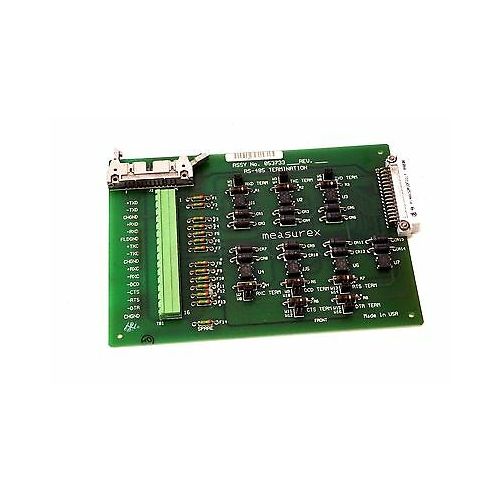
Honeywell control boards play a crucial role in managing heating, ventilation, and air conditioning (HVAC) systems, ensuring smooth communication between sensors, motors, and safety components. When these boards malfunction, even a well-maintained system can suddenly stop working or behave unpredictably. Because control boards act as the “brain” of the system, small faults can lead to larger performance issues if not addressed quickly.
Understanding the most common Honeywell control board problems can save valuable time during troubleshooting and repairs. With the right diagnostic approach, technicians and homeowners can often identify issues early, reduce downtime, and avoid unnecessary part replacements. This guide focuses on fast, practical methods to spot and diagnose control board problems before they escalate.
Most Common Honeywell Control Board Problems
Honeywell HVAC control boards are essential for system operation, but issues can develop over time. Spotting problems early helps prevent failures and costly repairs.
Honeywell Control Board Not Powering On
The board is not receiving or distributing power, preventing the system from starting.
Signs:
-
No power lights on the board
-
HVAC system is completely unresponsive
Causes:
-
Blown fuse or tripped breaker
-
Loose or disconnected wiring
-
Faulty transformer or power supply
Solutions: Check and replace any blown fuses or reset tripped breakers. Ensure all wiring is securely connected and test the transformer, replacing it if defective.
Honeywell Control Board Not Displaying
The board powers on but cannot show information due to display or internal connection problems.
Signs:
-
Board powers on but screen is blank
-
No LED or LCD display activity
Causes:
-
Damaged display screen or LED
-
Loose ribbon cables
-
Internal board failure
Solutions: Inspect and reconnect any loose cables to restore display function. Replace the display or consider replacing the board if an internal failure is detected.
Frequent System Lockouts and Safety Trips
The board repeatedly detects safety issues or misreads sensors, causing automatic shutdowns.
Signs:
-
System repeatedly shuts off
-
Error codes or flashing LEDs appear frequently
Causes:
-
Overheating or short-cycling
-
Faulty sensors (limit switch, flame sensor)
-
Wiring issues
Solutions: Check for airflow blockages or dirty filters and clean them. Test sensors and replace any faulty ones, and repair loose or damaged wiring.
Error Codes and Flashing LED Indicators
The board is signaling that a component or system fault has been detected, often displayed as a Honeywell control board error code.
Signs:
-
Board displays specific error codes
-
LED blinks in patterns signaling a fault
Causes:
-
Component failure (igniter, blower, transformer)
-
Short circuits or wiring issues
-
Sensor or thermostat malfunctions
Solutions: Refer to the Honeywell control board manual to identify the error codes. Test affected components and repair or replace any faulty parts.
Intermittent Heating or Cooling Operation
The board or its components are not maintaining consistent signals, causing sporadic system operation.
Signs:
-
HVAC system turns on and off sporadically
-
Uneven heating or cooling in the home
Causes:
-
Loose connections on the board
-
Failing relays or capacitors
-
Partially damaged circuits
Solutions: Inspect and secure all wiring connections on the board. Test relays and replace any that fail, or replace the board if circuits are damaged.
Control Board Failing to Communicate With Thermostat
The board is not properly sending or receiving signals from the thermostat, preventing system control.
Signs:
-
Thermostat shows “no connection” or “error”
-
System does not respond to thermostat commands
Causes:
-
Wiring issues between the thermostat and board
-
Incorrect thermostat settings or an incompatible model
-
Board firmware or internal failure
Solutions: Check thermostat wiring for loose or damaged connections. Verify compatibility and settings, update firmware if possible, or replace the board or thermostat if needed.
Looking to fix control board problems in your HVAC system? PartsHnC offers reliable HVAC parts and supplies, including replacement Honeywell control boards, thermostats, relays, and essential components from top brands like Honeywell, Trane, Carrier, Rheem, and Goodman. Keep your heating and cooling systems running efficiently and reliably all year long with our high-quality parts and expert support.
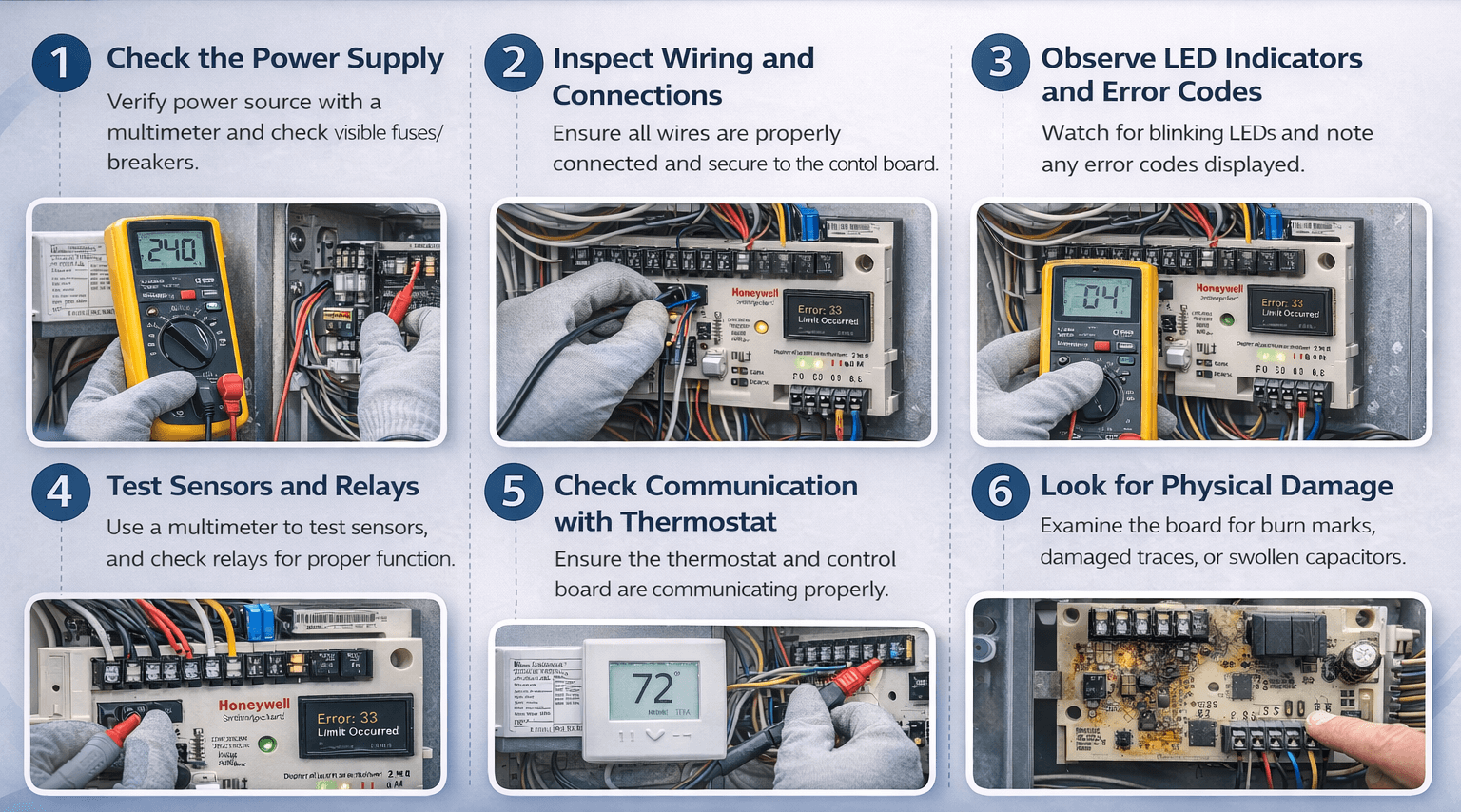
How to Quickly Diagnose a Honeywell Control Board Issue
Diagnosing a Honeywell control board failure efficiently can save time and prevent unnecessary part replacements. A systematic approach helps pinpoint the problem without guessing.
Common Causes Behind Honeywell Control Board Failures
While Honeywell control boards are robust, some hidden or overlooked factors can lead to failures. Being aware of these can help prevent repeated issues.
-
Voltage Fluctuations from Nearby Equipment: Small appliances on the same circuit can create micro-fluctuations. Over time, these stress damage the board’s components.
-
Improper Board Firmware or Software Glitches: Outdated or corrupted firmware can cause intermittent failures. It may also lead to lockouts or poor thermostat communication.
-
Electromagnetic Interference (EMI): High-power devices near the HVAC system can emit EMI. This interference disrupts the board’s delicate circuits.
-
Low-Grade Replacement Components: Non-OEM sensors, relays, or thermostats may miscommunicate with the board. This causes premature component failure over time.
-
Tiny Hairline Cracks or Cold Solder Joints: Heating and cooling cycles create micro-cracks in solder joints. These lead to intermittent malfunctions that are hard to detect visually.
-
Hidden Moisture from Condensation or Humidifiers: High indoor humidity or condensation can corrode circuits slowly. The damage is subtle and often hard to notice.
-
Poor Grounding or Electrical Noise: Incorrect grounding or weak shielding can let electrical noise interfere with signals. This stresses the board’s microprocessors.
Effective Honeywell control board troubleshooting helps detect issues early and prevent recurring HVAC system failures.
Honeywell Control Board Fast Fixes vs. Temporary Resets That Don’t Last
Many HVAC issues tempt homeowners to rely on quick resets, but these often mask deeper problems. Understanding the difference between real fixes and temporary solutions can prevent repeated failures.
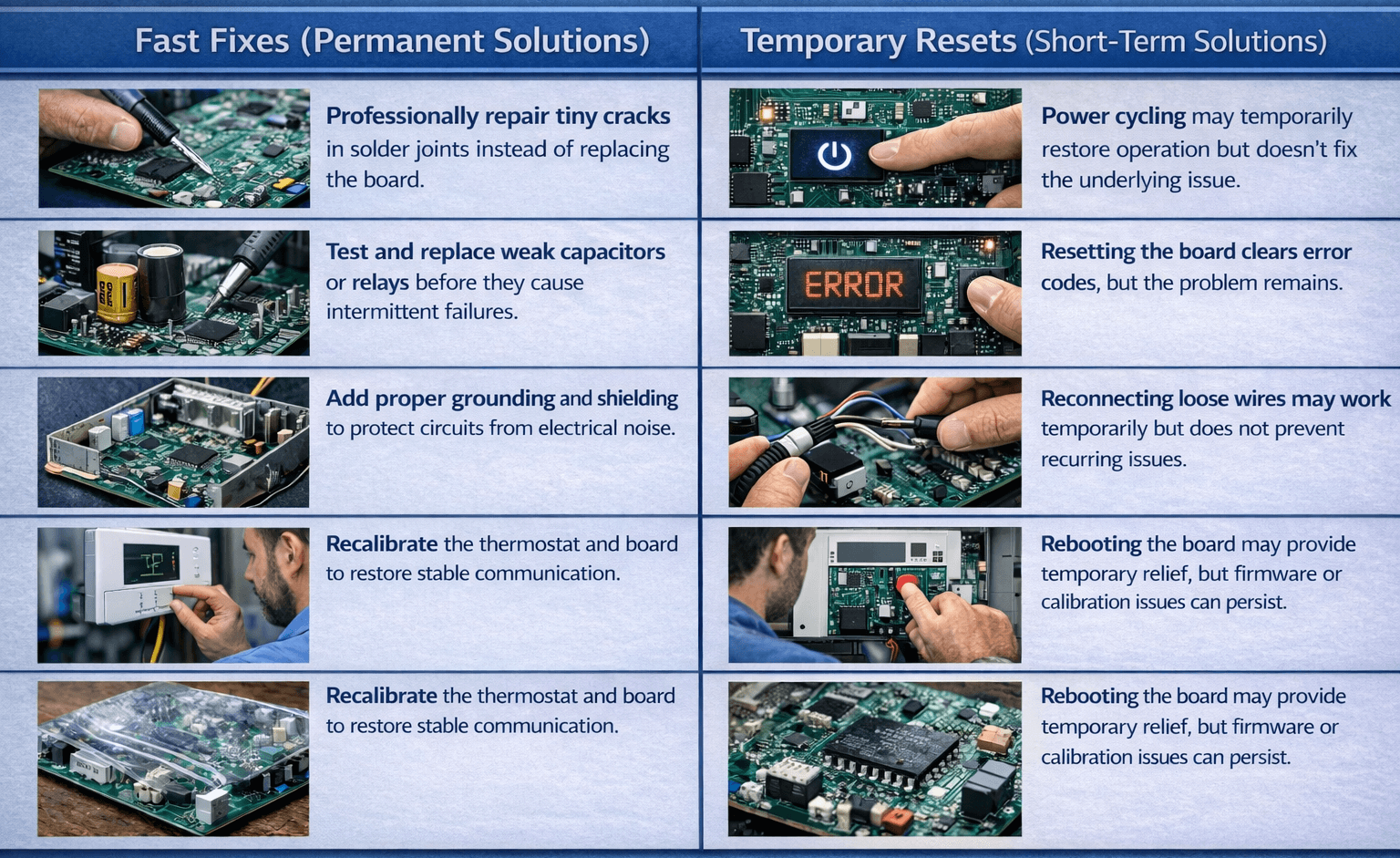
Tip: Quick resets may seem easy, but they rarely fix hidden issues. Focus on micro-damage and calibration.
Explore HVAC air conditioner: types, maintenance & troubleshooting, and learn how to keep your system efficient, extend its lifespan, and quickly resolve common issues.
When to Repair or Replace a Honeywell Control Board
Deciding whether to repair or replace a Honeywell control board isn’t just about cost. You also need to consider the board’s condition, system age, and the likelihood of recurring issues.
|
Problem |
Repair (When to Fix) |
Replacement (When to Replace) |
|
Board Not Powering On |
Blown fuses, tripped breakers, or loose/faulty wiring |
Internal board failure, burnt circuits, or irreparable damage |
|
Intermittent Heating or Cooling |
Weak relays, failing capacitors, minor solder cracks |
Frequent malfunctions, unstable operation, failing board |
|
Error Codes or Lockouts |
Faulty sensors, minor component issues, temporary glitches |
Persistent errors, repeated system lockouts, serious faults |
|
Thermostat Communication Failures |
Loose wiring, calibration errors, minor connection issues |
Processor faults, firmware corruption, and irreparable communication failure |
|
Physical or Environmental Damage |
Minor corrosion, damaged terminals, small component wear |
Severe burn marks, extensive corrosion, widespread board damage |
|
Aging Board with Repeated Issues |
Component wear, minor recurring failures |
Multiple failures due to age, end-of-life board replacement |
Check out how much does a furnace control board replacement cost to understand pricing factors, labor costs, and ways to save on repairs or replacement.
Conclusion: Ensuring Long-Term Reliability by Maintaining Your Honeywell Control Board
Honeywell control boards are more than just components—they are the central nervous system of your HVAC setup. Early recognition of subtle issues like delayed blower response or inconsistent thermostat signals can prevent bigger failures, and knowing when a Honeywell control board replacement is needed ensures long-term system reliability. While quick resets might provide temporary relief, understanding the root cause and being proactive with diagnostics and maintenance keeps your system safe, efficient, and trouble-free.
Key Takeaways:
-
Control boards can fail silently; watch for small inconsistencies in system behavior.
-
Environmental factors like moisture, dust, and vibration often contribute to failures.
-
Erratic Honeywell control board error codes may signal internal board faults, not just system malfunctions.
-
Testing the relay and capacitor function can reveal hidden weaknesses before total failure.
-
Some issues are intermittent and may not show up during simple inspections.
-
Timely replacement is often cheaper than repeated temporary fixes and system downtime.
Honeywell control boards are crucial to HVAC performance, and small warning signs often precede major failures. Understanding uncommon causes, performing detailed diagnostics, and acting decisively, whether through Honeywell control board repair or timely maintenance, can extend system life. Proactive attention keeps your HVAC running smoothly, safely, and efficiently.
FAQs
Why won’t my Honeywell control board power on even though the thermostat is working?
Often a blown board fuse, tripped breaker, or lack of 24 V transformer power is the culprit; start by checking power and fuses first.
How often should I inspect my Honeywell control board?
At least once a year, especially before the heating or cooling season, to check for dust, corrosion, or loose connections.
How much does a Honeywell control board cost?
Honeywell control boards typically cost between $150 and $500, depending on the model. Installation may add extra labor charges.
How do I wire a Honeywell dual zone control board?
Connect each thermostat to its zone terminals (R, C, W, Y, G) and link the HVAC equipment and dampers to the board. Always follow the model-specific wiring diagram and turn off power before starting.