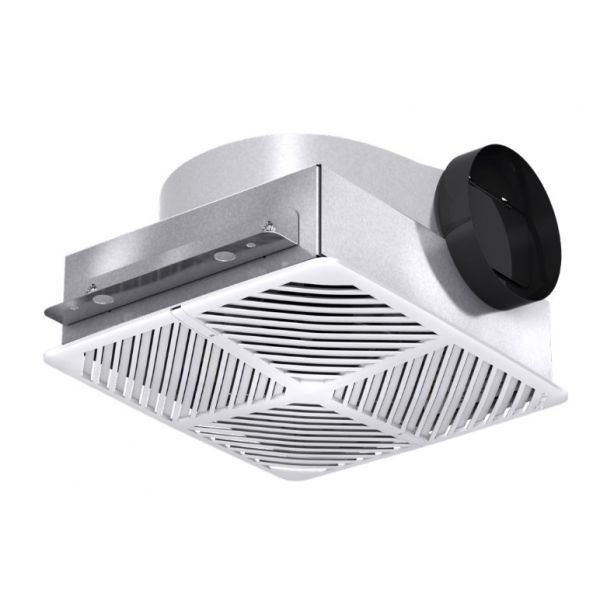
Bathroom and general clean-air spaces require controlled exhaust to remove unwanted air through a dedicated ventilation path. The Greenheck SP-B110-QD is a low-profile ceiling exhaust fan designed for bathroom and general clean-air applications, including residential, multi-family, and hotel environments. Its compact housing, centrifugal wheel, standard round outlet, and integral backdraft damper are designed around ceiling ventilation applications where controlled air removal is required.
Centrifugal Airflow Generation:
The exhaust fan generates airflow as its forward-curved centrifugal wheel rotates, drawing air into the housing and directing it toward the outlet. The direct-drive design transfers motor rotation directly to the wheel, allowing the fan to move air through the connected exhaust path. Its published airflow is 110 CFM at 0.125 in. w.g. static pressure, with airflow performance determined by the static pressure within the ventilation system.
Airflow Performance and Ventilation Path:
The SP-B110-QD is rated for 110 CFM at 0.125 in. w.g. static pressure, providing a defined airflow capacity for its intended ventilation application. Air is moved through the fan housing and discharged through the 6-inch round outlet into the connected exhaust path. The relationship between airflow and static pressure is important when matching the fan to the requirements of the ventilation system.
Ceiling Ventilation and Air Removal:
The fan's equipment-level role is to remove air from the served space and move it through the connected ventilation path. Air enters the housing, is moved by the centrifugal wheel, and exits through the 6-inch round outlet. The integral backdraft damper helps prevent unwanted reverse airflow when the fan is not operating, while the low-profile housing supports ceiling exhaust applications where available height is limited.
Replacement Guidelines:
The Greenheck SP-B110-QD Exhaust Fan may require replacement when the unit can no longer provide the airflow required for the served space. Fan failure, intermittent operation, persistent unusual noise, excessive vibration, or visible damage to the housing or centrifugal wheel can indicate that the assembly is no longer operating as intended. A backdraft damper that does not function as intended may also warrant replacement. Before selecting a replacement, confirm the required airflow capacity, 115V single-phase electrical configuration, outlet arrangement, and application requirements.
Common Failure Symptoms:
- Reduced or inconsistent exhaust airflow
- Fan fails to operate
- Intermittent operation
- Unusual operating noise
- Excessive vibration
Equipment Compatibility:
The Greenheck SP-B110-QD should be selected for ventilation systems requiring a ceiling exhaust fan with the corresponding airflow, electrical configuration, outlet arrangement, and physical requirements. Before purchasing, verify the existing product number, equipment requirements, and applicable specifications against the original manufacturer documentation.
Technical Specifications:
Part Identification:
Brand: Greenheck
Product Number: SP-B110-QD
Product Type: Bathroom Exhaust Fan
Electrical:
Voltage: 115V
Phase: 1 Phase
Frequency: 60 Hz
Mechanical:
Fan Type: Centrifugal
Drive Type: Direct Drive
Outlet Size: 6-inch Round
Control:
Backdraft Damper: Integral
Environmental:
Application: Bathroom and General Clean-Air Spaces
Installation Type: Ceiling
Airflow:
Airflow Capacity: 110 CFM
Static Pressure: 0.125 in. w.g.
 Loyalty Program