Facebook Pixel

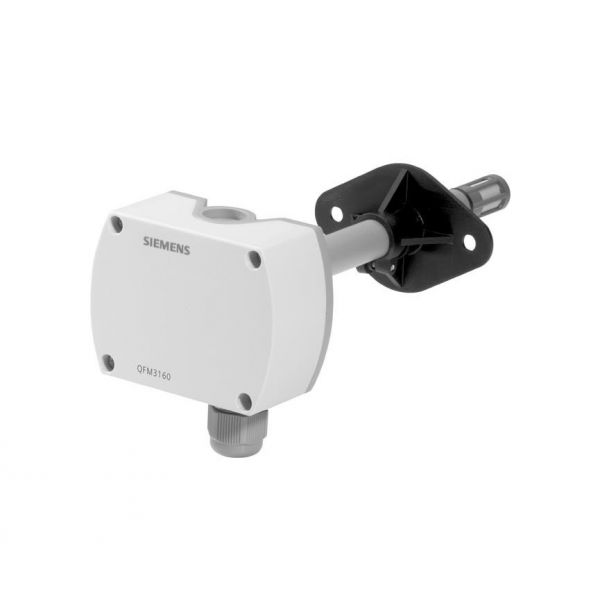
Siemens QFM3101 Duct Relative Humidity Sensor 2%

Special Price $239.62 Regular Price $265.98
In stock
SKU
QFM3101
The Siemens QFM3101 Duct Relative Humidity Sensor is a precision instrument for precise measurement of relative humidity in HVAC duct systems. Measuring range is 0 to 95% RH, and accuracy is ±2% RH. With a 4mA to 20 mA control signal, the sensor is compatible with many HVAC control systems. Screw terminals provide an easy path to wire the QFM3101 with 18 AWG wire and 13.5 to 35 VDC voltage operation. The sensor is constructed from durable poly material and is designed able to withstand the demands of an HVAC environment.
https://www.partshnc.com/media/catalog/product/q/f/qfm3101.jpg

Specifications

  • Type: Duct Relative Humidity Sensor
  • Measuring range: Humidity: 0 to 95% RH
  • Accuracy: ±2% RH
  • Connection: Screw Terminals
  • Control Signal: 4 to 20 mA
  • Input: 18 AWG wire
  • Operating voltage: 13.5…35 VDC
  • Material: Poly
  • Dimensions (W x H x D): 80 x 88 x 39 (274) mm
  • Weight: 0.47 Lbs
Manufacturer Name: Siemens Building Technology
Product Number: QFM3101
OEM Part Number: QFM3101
Product Description: Sensor,Duct Rg 2%
Weight:0.47lbs/213.19g

Choose the best HVAC equipment parts and supplies from PartsHnC!

  • Same Day Shipping

  • Best Quality And Best Price

  • Wide Range of Inventory

  • Best Customer Service

Have More Questions or Need Help to Place The Order?
Reach us at (866)773-0907 or [email protected]

Write Your Own Review
You're reviewing:Siemens QFM3101 Duct Relative Humidity Sensor 2%
Your Rating
Customer Questions
What maintenance is required for the Siemens QFM3101 Humidity Sensor?

Keep the humidity sensor clean and free from dust buildup to ensure accurate readings. Periodically inspect wiring and mounting for looseness or corrosion. Avoid condensation exposure and verify calibration during routine HVAC system checks.

What are common issues with the Siemens QFM3101 Humidity Sensor?

  • Drifting humidity readings due to sensor aging.
  • Dust accumulation in sensing element.
  • Wiring faults or intermittent signal loss.
  • Condensation damage in duct conditions.
  • Blocked airflow affecting measurement accuracy.
  • Loose mounting causing unstable readings.

Installation Steps

Step 1: Turn off HVAC control power and confirm safe isolation before handling wiring.

Step 2: Select a straight duct section with stable airflow and mark mounting location.

Step 3: Drill opening and insert probe to correct depth for accurate air measurement.

Step 4: Secure sensor housing tightly to duct surface.

Step 5: Connect wiring to control terminals per schematic.

Step 6: Restore power and verify humidity readings and stable system response.