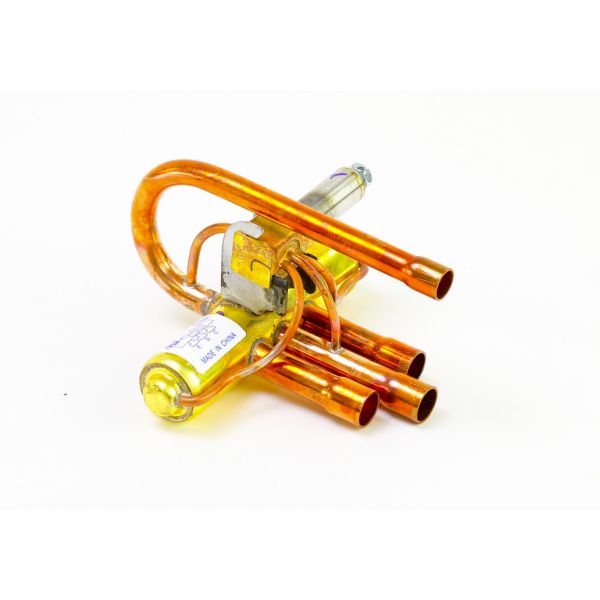
PRODUCT OVERVIEW:
As an essential flow control component in light residential and specialty heat pump systems, the York S1-VLHP-DSF4 Reversing Valve 1 Ton Dunan governs the direction of refrigerant flow to enable both heating and cooling functions. Manufactured by Dunan for York equipment, this 1-ton capacity four-way valve is installed directly within the sealed refrigeration circuit. By altering the routing of high-pressure discharge gas from the compressor, the component determines whether the indoor space absorbs heat during cooling calls or receives heat during heating calls.
REVERSING VALVE PRESSURE CONTROL:
Pressure conditions within the reversing valve influence the position of its internal switching mechanism. As the pressure relationship across the valve passages changes, the internal element moves to establish the appropriate connections between the refrigerant lines. This controlled pressure response changes which passages communicate with one another and redirects refrigerant through the selected circuit. The process provides the valve with the internal control needed to alter refrigerant direction during heat-pump operation.
HEAT PUMP THERMAL CYCLE CONTROL:
Heat-pump operation depends on establishing different refrigerant circulation patterns for heating and cooling. The reversing valve changes the circuit arrangement between the compressor and the indoor and outdoor heat-transfer sections, allowing those sections to exchange their roles within the refrigeration cycle. This change determines which section absorbs heat and which rejects heat during the selected operating condition. The resulting circuit configuration supports the thermal requirements of each mode.
REPLACEMENT GUIDELINES:
Replacement may be appropriate when internal slide binding, valve seat erosion, or internal bypass prevents the reversing valve from establishing the required refrigerant-flow condition. For the York S1-VLHP-DSF4, replacement may also be indicated when refrigerant leakage through the internal valve assembly interferes with proper separation of the circuit pathways or when physical deterioration affects valve operation. The replacement should be selected by matching the existing valve identification with the heat-pump model, refrigerant circuit arrangement, and applicable York parts documentation.
Common Failure Symptoms:
- Equipment stays locked in a single operating mode (heating or cooling) and cannot switch when requested by system controls.
- Reduced temperature differential across the indoor coil caused by internal high-to-low pressure refrigerant leakage.
- Heat pump fails to properly initiate, carry out, or exit automated outdoor coil defrost sequences.
- Equalized operating pressure readings between the suction and discharge lines during active compressor operation.
- Physical mechanical binding within the internal slider assembly that prevents full port alignment.
EQUIPMENT COMPATIBILITY:
The York S1-VLHP-DSF4 Reversing Valve 1 Ton Dunan applies to specific heat pump systems produced by the manufacturer. Before purchasing, verify that the replacement part matches the exact attributes listed in the Technical Specifications table, including the brand, part number, product type, equipment type, capacity, and manufacturer reference.
Technical Specifications:
Product identification:
Brand: York
Part Number: S1-VLHP-DSF4
Product Type: Reversing Valve
Equipment Type: Heat Pump Systems
Manufacturer: Dunan
Flow & capacity specifications:
Capacity: 1 Ton
 Loyalty Program